
8th ATHICFF – Iris Verhoeven : “I know it sounds a bit cliché… but do follow your dreams!”
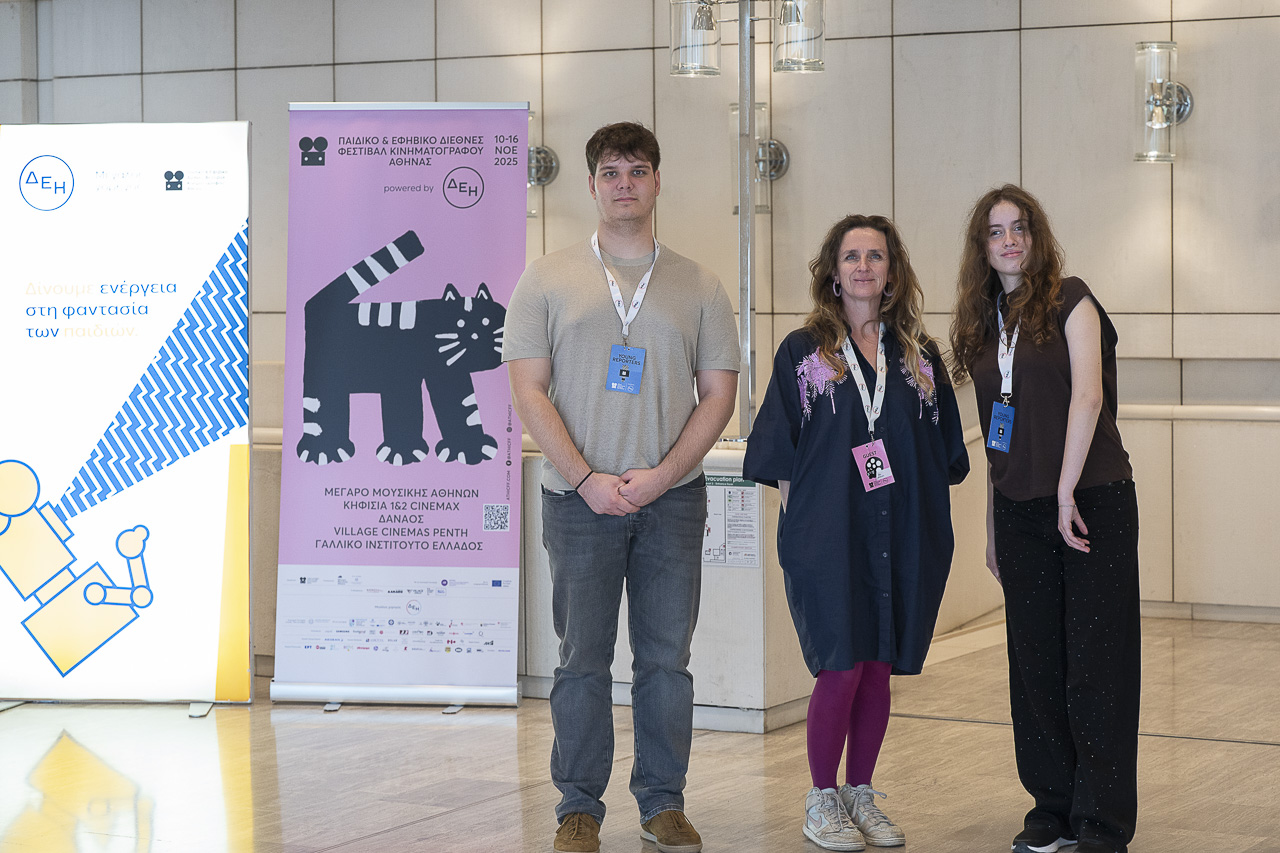
Iris Verhoeven, director of JEF and a member of our jury this year, is passionate about technology and all it has to offer in the fields of film and media. She spoke to enthusiastically about all the possibilities and encouraged us to always follow our dreams.
Interview by Young Reporters* (Dimitris Krontiras, Ifigeneia Stergioula)
Iris Verhoeven is the director of JEF, a film and games organization for young people in Flanders, Belgium. The organization is active in film distribution, film and media education, and organizes an annual youth film festival in several cities. The Festival has created the largest medialab in Flanders, as well as the platform “JEF in the Hospital” for children in hospitals and rehabilitation centers, with international outreach since 2018.
In the past, she served as financial director of the European Youth Film Festival for nearly ten years and has worked at the University of Antwerp and in other cultural organizations. She is a board member of institutions such as oKo and the Courtisane Festival. She studied Political Science, Cultural Studies, and Cultural Management, and in 2019 she completed the LinC leadership program (Utrecht University & Antwerp Management School).
-You head an organization (JEF) with a wide range of initiatives covering all aspects of what is known as film culture. What does this organization entail, and what inspired you to continue with it?
Well, I’ve been doing this for almost 20 years, so my driving force is that I’m so convinced—I always have been—of the power of images. When I was younger, I wrote letters to National Geographic asking them to hire me, but unfortunately, they never offered me a position! Later, in college, I took a course in visual anthropology, where we worked alongside film students. I studied anthropology, and that really inspired me, because you can tell so many stories through images! And then I worked at the university in the audiovisual department, and one day I had an interview with someone from the Youth Film Festival, which is a partner of JEF, and I thought, “Oh, that’ s a great organization!” And a year later, when a job opening came up, I said, “I want this job,” and I got it! That was 20 years ago, when my oldest son was seven months old, and that’s pretty much how I got started.
–Moving images, which are obviously very important to you, have evolved over time thanks to new technology. As the landscape changes, what motivates you to continue with JEF?
My mother was always ahead of the curve when it came to technology! She was the one who gave me my first cell phone, back when cell phones still looked like walkie-talkies. So we started out as a film festival, but very quickly we saw the potential of video games and audiovisual installations. I’ve always been interested in incorporating gaming into whatever we did, because I truly believe that kids love new technologies—VR, AR, and so on. After all, these are all tools for telling stories through images. So, I never thought in terms of boxes; on the contrary, I always said, “Let’s look at films in the broadest possible way!” That was our philosophy. Whenever there’s a new tool in the audiovisual space, we try to use it. Let me remind you that we don’t just work for the festival. There’s also the film distribution company and the film education company. So, all year round, every day, there’s a workshop somewhere in Belgium. Overall, I think we reach about a quarter of a million people, including film distribution.
We’re also experimenting with AI! Of course, artificial intelligence also comes with responsibility. You can run a workshop with AI, but there are always kids you have to explain things to. So, now we have a workshop with rich content. The same goes for gaming and VR. Let me give you a good example: there’s a movie shot from the boy’s point of view, but there’s also a VR version shot from the mother’s point of view. They were two separate stories, but it was really interesting to see both of them, because each one added another layer to the narrative. So, we do that kind of thing.
-Do you think artificial intelligence (AI) can benefit cinema, or is it a threat to creativity?
I’m optimistic; I’m not afraid! Of course, there are some concerns regarding artificial intelligence, such as the need for training in its use, privacy issues, the need to be critical of the images we see, but generally speaking, I believe that artificial intelligence is a form of democratization of the field. For me, it will never replace human creativity, because that is the most valuable thing we have as humans. AI simply repeats things we have already done. If it’s something creative, then whatever result AI produces will essentially come from our own minds. If we’re talking about a truly new idea, it can’t be produced by AI, precisely because artificial intelligence operates on existing ideas. So, I’m not afraid of that. People are much smarter! There are some scary things about AI, but overall, I believe it’s just another tool that democratizes many things that weren’t previously accessible to everyone. It will also make certain processes faster and more efficient. You can save time and money. I’m not afraid; on the contrary, I have high hopes for all of this!
-Many young people have second thoughts when it comes to studying film. Their parents or society often encourage more “conventional” careers. Do you think that participating in a film festival can change their minds about the film industry?
I’m not sure I see that. The young people who work at our festival as volunteers—and there are many of them—all come with a passion for film. Many of them are just 15 years old, so they don’t yet know what they’ll study, and they all have different personalities united by the same passion. It’s so beautiful to see them become friends, knowing that outside the Festival they might never have met, because they’re so different.
So, perhaps young people hesitate to pursue a career in the film industry because they listen to their parents, who aren’t always very encouraging when it comes to careers related to the arts, because art is never the easy path that will lead you to money and security.
But at the Festival, they see what is possible; for example, they see directors who struggled and then succeeded, as well as talented young people in various fields. For example, I remember some young visitors who came to the media lab when we were hosting students from a university specializing in gaming; the students explained many things to them, and the kids looked so excited, with their mouths open, saying: “I want to do that too!” That’s how horizons open up… you don’t have to be Steven Spielberg! There are many ways to make it happen!
-Many people are afraid of the arts; they’re afraid they might fail…
I have a wonderful example of a boy who was 16 years old when he started volunteering at our Festival. He was very shy. He had just dropped out of school, but every year he kept coming back to the festival. When he turned 19, he decided to take the exams to get his high school diploma. He succeeded, got his diploma, and then started studying at a film school. He made his own short film, which traveled to various places and won many awards! Now he works at a production company and also has premieres at our festival. I’m so proud of him! And he’s just one of the many teenagers I’ve watched grow up and find their way. There are plenty of other examples like this. You can follow the rules and play it safe, and then at 50 have a massive midlife crisis!
-If you hadn’t chosen the film industry, what else would you have chosen to do with your life?
I’m a cultural director, but I’ve always been fascinated by film culture in general. It’s always been a big part of my life. But if it weren’t for cinema, I think it would be fashion! When I was little, I wanted to be a fashion designer! I still love beautiful clothes!
-One last question: if you could give some advice to young people interested in this field, what would you tell them?
I know it’s a bit of a cliché… but follow your dreams! It’s the only way to live! Imagine choosing what your mother or your friends tell you to do, and doing it, and ultimately failing. That’s even worse—it’s a nightmare! But if you choose what your heart wants, even if it doesn’t work out, at least you’ll know you tried!
*Young Reporters is the journalistic team of our Festival, composed of young people aged 14-17 years old. The Young Reporters document what happens at the festival, interview creators, performers and professionals in the field, as well as the audience! They also do reporting, write film reviews, everything! Join our team.