
8th ATHICFF – Hidde de Vries: Hidde de Vries: “Children are much cleverer than we think and we should take them seriously”
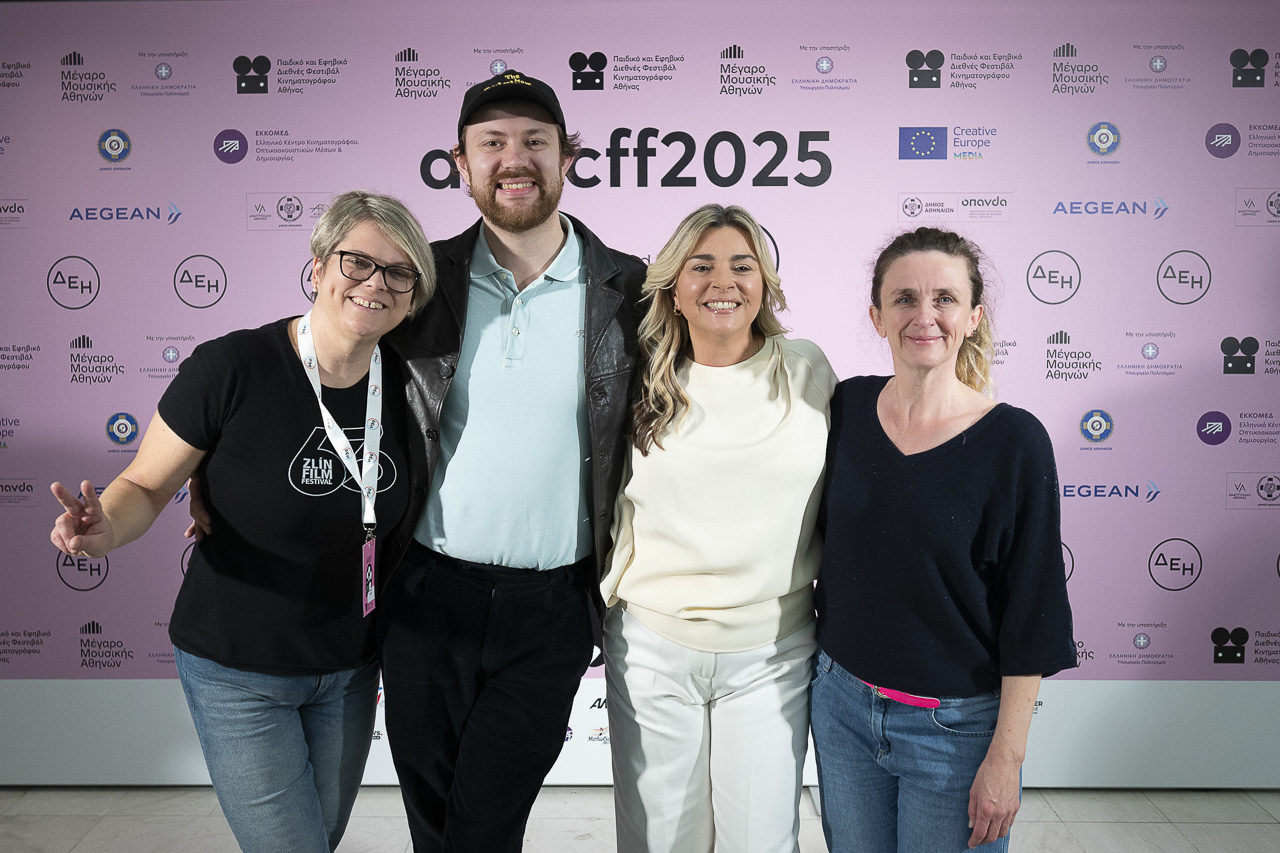
Hidde de Vries, member of our ECFA Jury this year, has a wide point of view on films and the Media Industry, has his own distribution company while being a member of Cinekid Festival. So, he has so much to share with us!
Interview by Young Reporters* (Elpida Papaioannou and Spyros Hatzantonis)
Hidde’s Bio
Hidde de Vries grew up in the north of the Netherlands and began volunteering at a local cinema at the age of eight. He later studied Production at the Netherlands Film Academy. In 2020, he completed a master’s degree in Creative Producing at the DAS Graduate School. After several years of producing, he shifted his focus to distribution and the visibility of films and their talent. He does this at Kapitein Kort, his distribution company for short films, at Cinekid Festival as head of the Films & Series department, and as the president of the board of the Dutch Association of Small Cinemas (VVF), which he founded in 2021.
-You run a short film distribution agency promoting young filmmakers to reach bigger
audiences. How can one achieve that?
During my studies at film school, I made some films and that was when I first thought “well, if you make a film, you should really get an audience! Someone should see it!”. So,
I started sending some of those films to festivals, and I got lots and lots of people, leading to more and more people, and then all this snowballed to this company which was suddenly helping many people. That’s because when I was younger, my mom used to run voluntarily a cinema of 30 seats, situated in a basement in the village where I’m from. I was nine years old and already part of the team, so for me cinema is really about watching films together, sitting together in the dark.
So that’s why I think it’s very important that films get seen. Most of the time filmmakers, especially the ones that make their first film, which is itself already very hard, they don’t know how to get it to a cinema, how to get it into a festival. So, I would say, I help filmmakers with that.
-As you have just told us you began volunteering at the age of nine. What is your earliest memory of when you thought for the first time “oh, this is what I want to do with my life!”?
The thing is I’m 32 now, so I already consider myself quite old! And when you’re becoming a bit old, sometimes, you don’t know if something is a memory or a photo that you remember. But, generally speaking, my earliest memory towards that place is just me sitting behind tickets’ desks and selling tickets to kids. And the fact that at first, I wanted to become a director. When I was young, I thought this was the only thing you can become. After high school though, I started studying in a film academy not as a director but as a producer. Then after film school, I moved all the way from making films because I realized I wanted to put all my time into getting films seen instead of making them.
-You also work with young creators. What are the themes that interest them the most?
I think a lot of their films are about growing up, becoming older or learning something while growing up. Themes like identity, finding who you are as a person, love etc. -these are very common themes among young filmmakers.
-As the founder of an association for small cinemas, what challenges would you say they face?
It’s an association for cinemas, the same kind of cinema my mom used to run, for the small ones. There are almost 200 of them in the Netherlands and they are all run by people who are now old. So, I thought that if we don’t do something, they will disappear! So, I had this idea of making them work together on the issues they face because on their own they can’t do a lot, but together they are stronger! The biggest issue with these places is that they have problems with getting younger people to become interested in volunteering. So, that is something we are working on.
-We were also wondering how do you decide which film you will represent? What does it have to have?
It’s very hard to say. I would say that it would be a feeling. Films should always have something to tell us about the world that we’re living in, that means to put the lens literally on something that we, as society or as people individually, don’t really know about. It’s about learning something about people, a feeling. But in general, if I cry while watching a film, it’s always a good one! That is a good selection criterion! Or if I keep thinking about the film after watching it!
-You also work for Cinekid. What is the main aim of the festival and its characteristics?
Cinekid is the most fun film festival for children in the world! We shouldn’t say that here (laughs)! We have been doing it for almost 40 years! It’s a very old organization and because of that it had the possibility to really grow and become a big thing! Every year we organize a film festival in Amsterdam but also in 40 locations in the outer Netherlands at the same time. That way we are able to reach around 70.000 kids that come to the festival! What makes Cinekid so fun is that it’s not only a festival. We also have a very huge media lab, an interactive playground for kids, which has VR, AR, games, installations. It’s 2000 m² “playground”- a space to play and discover stuff which I think is really fun!
-What are your main criteria when selecting a film for Cinekid?
I would say that for us it’s very important that the film take the perspective of the kids. A lot of films that have as a main character a kid, are about the kids, but they don’t come from their perspective. So, the film should be done from the eyes of the child instead of a grown-up who tells a story about a child because, we think, in this way, kids can relate better to the film.
-What kind of movies do kids enjoy watching nowadays?
Oh, not a lot! I think kids do watch films, but also Media has grown so much, that they offer different kinds of content and as a result they consume lots of children’s time. Kids are now watching series, they are on Netflix, they are doing a lot of gaming, there are so many different ways to interact with media. But in general, kids love films that are funny. It needs to be fun!
-Do you feel that kids cannot concentrate nowadays because of all these diverse types of media (social media, YouTube, platforms) as to watch a movie? If so, how could we address this?
I also watch a lot of short film content, so my brain is wired to do the same. I think cinema as a place where there is a screen helps already to put you into concentration mode. While being at home on your phone or your screen is making it hard to watch a long film. But in a cinema, you are much more focused because you are in a completely dark room with a very big screen and good sound and it’s easier to put emphasis on that experience. Kids can still do it! But what we can also do is to show short films in compilation with multiple short films for one hour, so that kids can have a little bit of diversity. This way they can see different kinds of films and I think that also helps.
-Still kids movies shouldn’t be “childish”. Right?
Yes, kids are way cleverer than we think! What you’re saying now, for example, is a very clever thing to say! We shouldn’t treat them as babies! Of course, there is some science about certain ages and what they can understand. For example, very young kids can’t really see if something is real or fake, so of course there are some things that you need to take account of, but in general, kids are much smarter and we should take them seriously!
-What is this one project that you have dreamt of creating but you have stopped pursuing it?
One project that I would love to do and it has not been realized yet, is something a bit more personal! As I told you earlier, when I grew up in a cinema and I was always part of that community, so for me, a dream is to once have my own cinema or run a cinema! It would be great because then I could accomplish all my ideas! Sometimes, when you work for a festival like I do, you work almost a year for only two weeks of festival, but if you have a cinema you can do, for example, a screening every week or a fun event every month, stuff like that. So, sometimes I crave having a cinema!
-One last question: if you had a chance to collaborate with any filmmaker alive or not, who would be and why?
Oh my God! Difficult question! One of my favorite film directors is Scorsese, so I would love to work with him, to see first if I can ever talk to him, that would be interesting! It’s always a bit weird, you know, never meet your hero, people always say! I had met one of my heroes once and it was not a great experience! So never meet your hero, sometimes it is better!
-Thank you very much!
*Young Reporters is the journalistic team of our Festival, composed of young people aged 14-17 years old. The Young Reporters document what happens at the festival, interview creators, performers and professionals in the field, as well as the audience! They also do reporting, write film reviews, everything! Join our team.